

The criteria to issue our Seasonal MACD Sell signal for the Dow Jones Industrial Average and S&P 500 Index (^SPX) is a new sell signal after the first trading day of April. Both DJIA and S&P 500 have to agree, notes Jeff Hirsch, editor-in-chief of The Stock Trader’s Almanac.
For example, if DJIA’s Seasonal MACD indicator turns negative, but S&P 500’s does not, then there is no signal on that day. Both must be negative. Our Seasonal MACD Sell indicator is calculated using daily closing prices with a short exponential moving average (ema) of 12, a long ema of 26, and a 9-period ema for the signal line. This is frequently written as 12-26-9 – or in the accompanying chart as 12, 26, 9.
(Editor’s Note: Jeff is speaking at the 2026 MoneyShow Masters Symposium Hollywood Florida, scheduled for April 9-11. Click HERE to register).
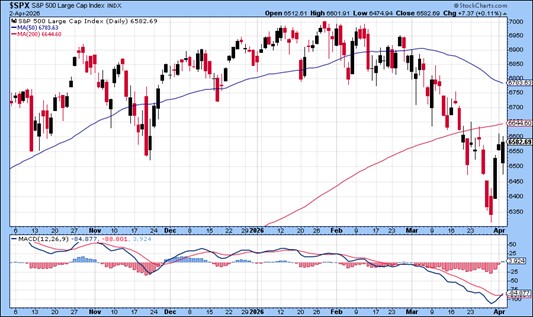
As of last Thursday’s close, MACD indicators applied to DJIA and S&P 500 are positive. DJIA would need to drop over 2088 points (–4.49%) in a single day to turn its MACD indicator negative. S&P 500 would need to decline over 159 points (–2.42%) to turn its MACD indicator negative.
So, continue to hold long positions associated with DJIA’s and S&P 500’s “Best Six Months.” We will issue our Seasonal MACD Sell signal when corresponding MACD Sell indicators applied to DJIA and S&P 500 both cross over and issue a new sell signal.