

Why is the market ignoring the risk arising from the shuttering of the Strait of Hormuz? Because the supply shock has been buffered, the market has already done the math, and traders have moved on. What's replacing geopolitics as the driver? Earnings, writes Lance Roberts, editor of the Bull Bear Report.
That’s what price action is telling us. The S&P 500 Index (^SPX) has pushed through Hormuz headlines the same way it pushed through tariffs, Federal Reserve succession noise, and March’s banking tremors. At some point, markets stop pricing risks they’ve already metabolized.
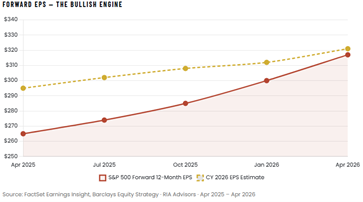
With earnings, the data is unambiguously bullish. With 10% of S&P 500 companies reporting for Q1, 88% have beaten EPS estimates, well above the 10-year average of 76%. The aggregate beat sits at 10.8%, versus a historical 7.1%.
Analysts have revised full-year 2026 earnings growth to 18%. Forward 12-month EPS has pushed the bottom-up index target to roughly $7,350, up 13% from the May 14 low. The estimated 2026 net margin of 13.9% would be the highest on record.
Do I buy the whole bullish read? Mostly, with a caveat. Stocks do follow earnings over time, and the earnings trajectory here is genuinely strong. But forward estimates almost always rise until they don’t. That’s the normal pattern, not a signal.
The forward 12-month P/E is 20.9, above both the 5-year (19.9) and 10-year (18.9) averages. At those multiples, a clean beat earns a muted reaction, and any Q2 guidance that embeds the $4+ gasoline hit to the consumer gets punished hard. The market is right to pivot. But it’s also walking a thinner ledge than the headlines suggest.