

SpaceX (SPCX) is now officially a publicly traded stock. One of the more interesting IPO sideshows was the delay – if only by ONE trading day – of the rollout of single-stock ETFs targeting the name. I say “interesting” because those products have been multiplying like rabbits!
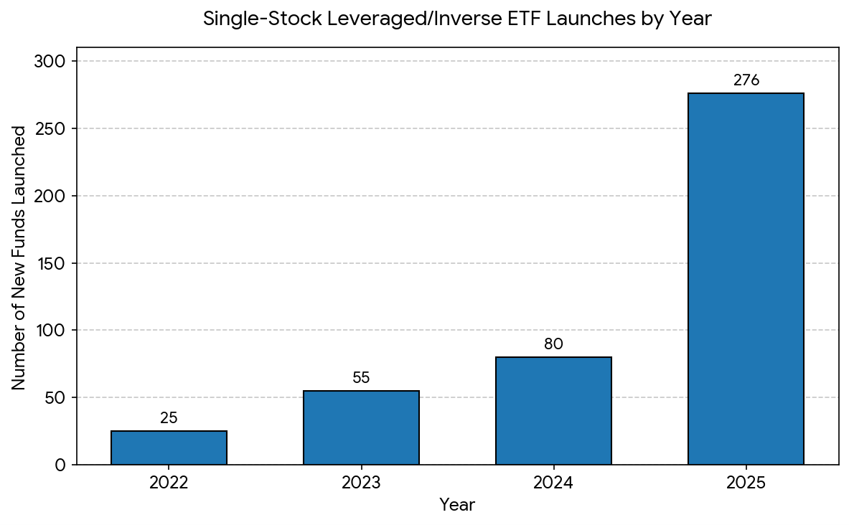
Take a look at my MoneyShow Chart of the Day. It shows the number of single-stock ETFs, including leveraged long or short and unleveraged inverse funds, that were launched by year since 2022. That’s the year the Securities and Exchange Commission (SEC) permitted the rollout of such funds.
Source: Google AI Assistant (Retrieved 6/12/26)
You can see that only 25 ETFs hit the market in 2022. That more than doubled to 55 in 2023, then climbed to 80 in 2024. Last year? Rollouts more than TRIPLED to 276!
You can now get 2X leveraged long exposure to Micron Technology Inc. (MU), Tesla Inc. (TSLA), or Marvell Technology Inc. (MRVL). You can get 2X leveraged short exposure to Strategy Inc. (MSTR) and Nvidia Corp. (NVDA). Pick any highly popular stock, especially in the technology sector, and you can probably find one or more ETFs to go long – or short – it via an ETF...with leverage to boot!
But when it came to SpaceX, regulators reportedly forced several ETF sponsors to wait until today to roll out their single-stock ETFs. The reason? Worries a simultaneous introduction could cause glitches with the SpaceX IPO.
I doubt that minor delay will derail the powerful issuance trend in place since 2022. It would probably take something like a volatility explosion or serious bear market to do that. They would fuel widespread losses, introduce tracking problems, or cause investors to lose interest.
But if you’re exposed to these types of ETFs, keep in mind that compounding decay and higher expenses make them more appropriate for short-term trading than long-term investing. And make sure you’re not employing too much collective leverage in your portfolio – in case something were to hit the proverbial fan!