

I’m old enough to remember the popularity of leveraged SECTOR ETFs before, during, and after the Great Financial Crisis. Now, leveraged SINGLE-STOCK funds are all the rage – and concerns are growing in some quarters.
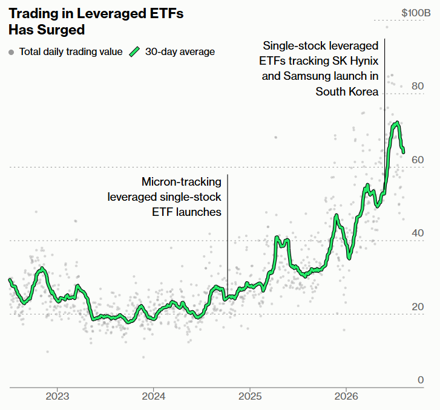
Take a look at the MoneyShow Chart of the Day here, which comes from Bloomberg. The media outlet notes that the roughly $250 billion in leveraged ETF assets globally amounts to only 1% of total ETF assets under management (AUM). But those funds are so popular among the fast-money crowd that they account for 16% of ETF daily trading activity.
Source: Bloomberg
In fact, trading volume roughly tripled between January and June. Many of the ETFs are tracking the same handful of tech indices or individual AI, tech, and hyperscaler stocks, too – including Nvidia Corp. (NVDA), Micron Technology Inc. (MU), Alphabet Inc. (GOOGL), and the South Korean shares of SK Hynix Inc. (SKHY).
Right now, the highest trading volume and AUM figures belong to ETFs like the GraniteShares 2X Long NVDA Daily ETF (NVDL), Direxion Daily MU Bull 2X ETF (MUU), and Direxion Daily TSLA Bull 2X ETF (TSLL). If you’ve traded them, then you know you can rack up gains more quickly. But the same is true for losses. Tracking error also grows the longer you hold a leveraged fund targeting a volatile underlying stock.
Then there’s the question of whether these ETFs introduce more systemic risk. Things got so bad in South Korea – with retail investors loading up on $9.7 billion in single-stock leveraged ETFs, only to get crushed when chip stocks tanked – that the country’s finance minister apologized in parliament. Market regulators suspended approval of new funds and are discussing other risk curbs.
There’s no sign US officials will do the same. But if we DO get a market “event” down the road, who knows what might happen? The bottom line: If you’re trading leveraged ETFs, know what you’re getting in to – and be honest with yourself about the risks involved.