

September didn't live up to its historical weakness reputation for the mega-cap indices, but it certainly put a hurting on sectors, industries, and individual stocks. The S&P 500 Index (SPX) closed the month with a tiny loss, while the S&P Midcap 400 fell 4% and the S&P SmallCap 600 lost 6%, notes John Eade, president of Argus Research.
Information technology ripped higher by 5% in September, but for many of the other large-cap sectors, the month was ugly. Financial and materials fell 7%; real estate, utilities, and consumer discretionary all gave back 6%; and industrials and consumer staples lost 4%.
S&P 500 Index (^SPX)
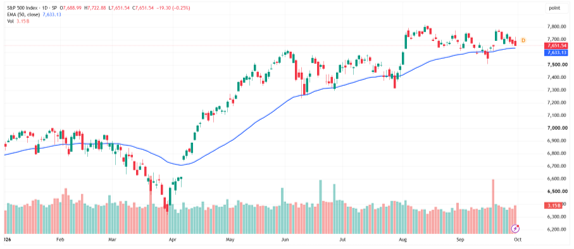
Source: TradingView
Some of this weakness is clearly a function of higher energy prices, as WTI crude oil and gasoline jumped 6% — and yields across the Treasury curve ripped higher. Both 2-year and 10-year yields spiked more than 50 basis points, sending 30-year mortgage rates to 7.4%-7.6% (the highs from October 2023).
Information technology strength came from a 9% surge by the VanEck Semiconductor ETF (SMH), as well as a 6% jump in computer hardware and electronic equipment. Meanwhile, weakness was broad across many other industries, leading to a rough breadth condition.
In 21 days, the percentage of SPX stocks above their 200-day fell to 43% from 68% and the Invesco QQQ Trust (QQQ) dropped to 53% from 68%. Currently, there are very bullish seasonal studies and very bearish breadth studies.
Yields most likely will decide which study wins. If there is a continued spike, look out below, while a reversal of a very stretched condition should make stocks fly.