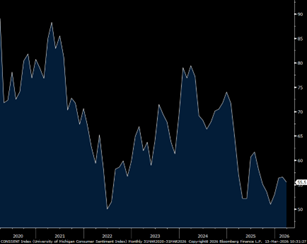
Reflecting some answers pre- and some post-the start of the war, the University of Michigan Consumer Confidence Index slipped a modest 1.1 points in March to 55.5. That was a bit better than the estimated 54.8. The internals were mixed, though, as current conditions were up while expectations fell, writes Peter Boockvar, editor of The Boock Report.
After seeing the Q4 GDP data, growth averaged about 2% in 2025. The Q425 versus Q424 growth rate was also 2%. In light of everything thrown at the economy – meaning the tariff barrage and on and off use of them – 2% is pretty good. But we know how bifurcated the contribution was, with data center buildouts in particular making up almost half of that growth.
University of Michigan Consumer Confidence Index
Meanwhile, one-year UoM inflation expectations did not lift with the sharp rise in gasoline prices...yet. They held at 3.4%, while the 5-10 year guess fell by one-tenth to 3.2%. So, maybe the belief that prices in other things will trend lower offset the rise in energy prices...and the filtering through to other things that came from that.
Still, the impact from higher energy prices directly via gasoline prices and/or heating and cooling bills is not just a percent-of-income thing. Energy prices impact so many other things (transportation, packaging, clothing, etc.) and it takes time to flow through to surveys if sustained.
As part of the survey took place before the war and the balance after, this is what UoM said: “Interviews completed prior to the military action in Iran showed an improvement in sentiment from last month. But lower readings seen during the nine days thereafter completely erased those initial gains. Gasoline prices have exerted the most immediate impact felt by consumers, though the magnitude of passthrough to other prices remains highly uncertain.”