The idea behind my “Cockroach Portfolio” is straightforward: Build something that can survive just about anything the market throws at it. Not by trying to predict the next crisis, but by combining exposures that historically behave differently across economic environments, says Tony Dong, lead ETF analyst at ETF Central.
In ETF terms, that means leaning on diversification instead of expensive hedging. No options overlays, no constant negative carry. Just a handful of low-cost ETFs that, when combined, have historically delivered strong risk-adjusted returns relative to both the S&P 500 Index (^SPX) and a traditional 60/40 portfolio.
Implementation is straightforward. Allocate 20% to each of the five ETFs and rebalance quarterly. That brings the weighted average expense ratio to just 0.076%.
Instead of broad market exposure, the equity sleeve is split evenly across three defensive sectors: the State Street Health Care Select Sector SPDR Fund (XLV), the State Street Utilities Select Sector SPDR Fund (XLU), and the State Street Consumer Staples Select Sector SPDR Fund (XLP).
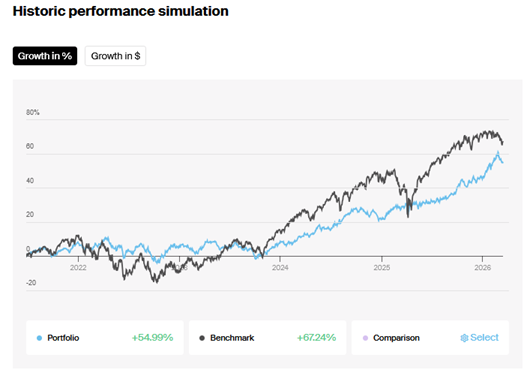
The bond sleeve is allocated to the iShares U.S. Treasury Bond ETF (GOVT). Its role is diversification. Treasury bonds are driven by interest rates and macro conditions, not corporate earnings.
The final piece is gold, held through the iShares Gold Trust Micro (IAUM). Gold brings something different to the table. It has low correlation to both stocks and bonds and tends to perform well in environments where traditional assets struggle together.
Against the S&P 500 total return index, this portfolio has lagged over the past five years, which is expected in a strong equity bull market. But the tradeoff shows up clearly in the Sharpe ratio, which increases to 1.08 from 0.67. In other words, you are getting more return per unit of risk taken.
This is not a portfolio designed to shoot the lights out. It is designed to endure. For investors looking for a more-balanced, cost-efficient alternative to complex and expensive all-weather strategies, this is a practical way to get there using just a handful of low-cost index ETFs.