
With the first half of 2026 concluded, history implies (but does not guarantee) that despite the possibility of short-term volatility, second half (H2) gains will likely follow H1’s positive returns, observes Sam Stovall, chief investment strategist at CFRA Research.
First, the S&P 500 Index’s (^SPX) 24 all-time highs through June 26 place it among the top 20 H1s since WWII. In H2 of these prior top-20 years, the S&P 500 gained an additional 6% — and rose in price 80% of the time.
(Editor’s Note: Sam will be speaking at the Investing in Alternatives Virtual Expo, scheduled for July 8-9, 2026. Click HERE to register.)
Second, for all years since WWII, the S&P 500 posted a H2 price increase 72% of the time. Following a positive H1, that H2 batting average rose to 77%. Better yet, if H1 gained more than 5%, H2 saw an additional advance an average of 81% of the time. This series of improvements in batting averages also occurred during midterm election years (MTEYs).
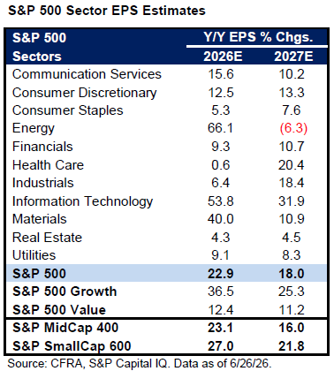
Third, S&P 500 earnings per share are forecast to rise 22.9% in 2026, according to S&P Capital IQ, versus 12.8% growth in 2025. Then they should advance 18% in 2027. Roughly 82% of the 155 subindustries in the S&P 1,500 are seen posting year-over-year EPS increases in 2026 and 95% in 2027.
Still, volatility can’t be ruled out. Some 45% of all MTEY H2s experienced declines of 5% or more. This is the 12th “WAVE” Administration (Presidency, House, and Senate controlled by the same party) since 1946. Only 36% of prior WAVEs retained this status after midterm elections: Truman, Kennedy, Johnson, and Carter. None were Republican.