
After more than a decade of mega-cap technology company domination during which market-capitalization-weighted indices like the S&P 500 Index (^SPX) became overwhelmingly concentrated in a handful of giant firms, a long-awaited market rotation took root in late 2025 – and accelerated through mid-2026, says Doug Gerlach, editor of SmallCap Informer.
As AI capital expenditures faced heightened scrutiny and large-cap valuations reached historic highs, capital flowed decisively in the other direction — into domestic small-cap equities. By mid-2026, the S&P SmallCap 600 Index posted year-to-date gains exceeding 19% and trailing 12-month returns above 33%, comfortably outpacing the S&P 500.
For individual investors and portfolio managers following a disciplined Quality and Growth At a Reasonable Price (Q-GARP) strategy, this rotation raises a vital question: Is the current small-cap bull rally merely a brief, tactical catch-up phase, or the opening chapter of a multi-year secular leadership cycle? And how long can it realistically endure?
Looking at historical capitalization cycles, relative valuation discounts, consensus earnings growth variances, and macroeconomic tailwinds suggests that this small-cap expansion just might have the fortitude to last several years, provided key earnings and credit conditions hold.
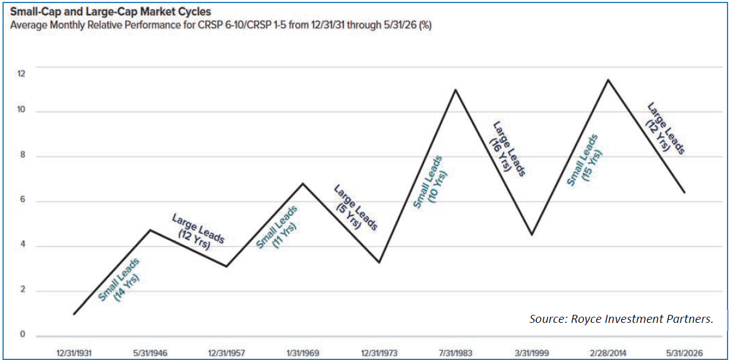
Chuck Royce and Royce Investment Partners examined eight capitalization outperformance cycles from 1931 through mid-2025 and revealed clear duration patterns. Small-cap outperformance cycles have historically averaged 10 to 15 years in duration before large-caps took over. Then, large-caps outperformed for five to 16 years until the situation reversed.
The most recent large-cap cycle lasted approximately 12 years (2014–2025), driven by tech-heavy index weighting and low-rate environments favoring global mega-caps. Following the 1999 technology bubble, the Russell 2000 Index and S&P SmallCap 600 entered a long bull market (the Post-Dot-Com Rotation), going on to outperform the S&P 500 in 14 out of 21 years between 2000 and 2020.
If the current market cycle follows historical norms, the 2025–2026 small-cap breakout looks to represent the early stages of a broader multi-year cycle rather than a late-stage rally.