
The highly anticipated Federal Reserve’s new rate-tightening cycle is now underway. Two conflicting scenarios come to mind when it comes to the impact on the S&P 500 Index (^SPX), opines Sam Stovall, chief investment strategist at CFRA Research.
As expected, the Federal Open Market Committee (FOMC) unanimously voted to raise the Fed funds rate by 25 basis points (bps) to the 3.75%-4% target range. During the press conference following the rate hike announcement, Fed Chair Warsh said that “inflation was still too high,” indicating that unlike the one-and-done 25 bps hike on March 25, 1997, additional rate hikes are likely to follow.
Uncertainty remains as to the overall effect of the new cycle on this bull market – and questions abound as to whether the speed and magnitude of future rate increases will dictate the possible depth of response in equity prices.
Early in February 2004, the Fed announced the first of its eventual seven hikes in 12 months that doubled the Fed funds rate, yet resulted in only a pullback of less than 9%. Six hikes from mid-1999 and into Q2 2000 pushed rates up by less than 2%, yet preceded a correction of 12% in 1999, and likely contributed to the popping of the tech bubble in late March 2000.
Despite the last new all-time high on the S&P 500 in mid-August that was accompanied by rising oil prices and stubbornly high inflation, gradually rising expectations of higher rates caused the S&P 500 to post a cumulative decline of only 3.2%, as of the close of trading on September 16.
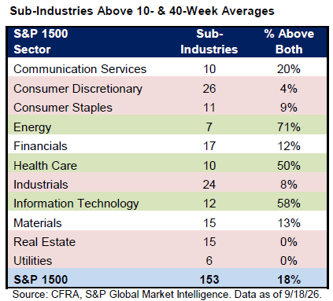
In a further show of surface stability, the market then experienced two days of price recovery, leaving the S&P 500 less than 2% below the prior high. The real question today is whether the shrinking spiral of subindustry participation portends additional downside. While we think a pullback or correction is possible, we think the market may be hinting at a near-term bounce back.