
Market and specific sector volatility can either cause elevated stress or provide seriously beneficial income to one’s portfolio. The current market environment represents the structural sweet spot for covered-call income ETFs, notes Bryan Perry, editor of Cash Machine.
Over the course of the past six months, the majority of the market’s eleven sectors have endured fairly extreme levels of volatility. In markets such as the present, taking full advantage of implied volatility means selling option premiums back to the marketplace and capturing outsized option premium-related income.
State Street Energy Select Sector SPDR ETF (XLE)
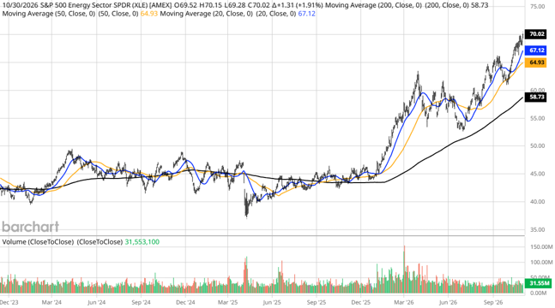
Think about it: In a choppy tape, pure equities generate sluggish capital gains but covered-call funds capture fat upfront option premiums. They outperform static buy-and-hold strategies without suffering from the capped-upside drag that occurs during parabolic market melt-ups. Applying this methodology works best in a sector that is technically overbought.
The energy sector fits this profile and strategy to a tee. Be it the integrated major oil companies or the exploration and production companies, the top holdings in the State Street Energy Select Sector SPDR ETF (XLE) account for 78% of total assets. Shares of XLE have rallied 55% over the past three months.
With WTI crude trading at around $104 per barrel as of last Friday, WTI is near the high end of its long-term historic range. Option premiums have expanded meaningfully over this three-month stretch. Hence, it stands to reason that staying long the sector while banking historic call premium makes good portfolio sense, whether done individually or with ETFs or closed-end funds.