Stocks rallied yesterday after a door to some kind of Middle East deal was opened. But the gains faded modestly by the close. A wave of attacks and counterattacks by Israel and Iran overnight has markets back in a skeptical mood, with equities and Treasuries lower and oil rising about 4%. Iran struck other targets in the Persian Gulf, too, leading to speculation countries like Saudi Arabia or the United Arab Emirates could even join the fight.
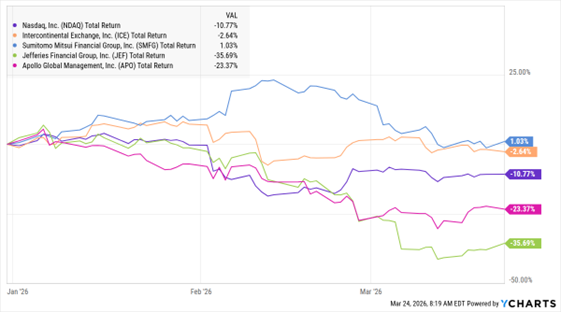
NDAQ, ICE, SMFG, JEF, APO (YTD % Change)
Data by YCharts
On the heels of yesterday’s Nasdaq Inc. (NDAQ) deal, the New York Stock Exchange is taking its own step toward blending the traditional and blockchain-based trading worlds. The NYSE will partner with Securitize to set up a digital transfer agent system – a move that will facilitate trading in tokenized stocks and ETFs. The NYSE is owned by Intercontinental Exchange Inc. (ICE).
Meanwhile, a cross-border financial deal may be in the works, according to the Financial Times. The FT reported that Sumitomo Mitsui Financial Group Inc. (SMFG) is considering taking over Jeffries Financial Group Inc. (JEF). The Japanese financial conglomerate already owns a 20% stake in New York-based Jeffries – and may take the step amid a selloff in Jeffries’ shares. Jeffries sports a market capitalization of $8.2 billion, compared with $124 billion for SMFG.
Lastly, private credit problems continue percolating in the background. Apollo Global Management Inc. (APO) became the latest fund manager to limit redemptions by investors. Holders of 11.2% of the shares in its Apollo Debt Solutions fund asked for their money back, leading Apollo to cap redemptions at 5%. Private funds are designed to offer higher returns in exchange for certain tradeoffs, including less liquidity. But investors are asking for their money back anyway amid worries about rising credit losses.