
Equities sagged into the close yesterday, and they remain under pressure today thanks to a continuing selloff in government bonds. Crude oil is modestly higher, while gold, silver, and crypto are slightly lower.
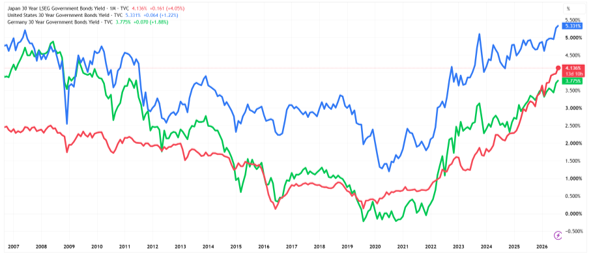
AI stocks have ceded the spotlight to interest rates for a change. Longer-term bonds are selling off in the US and around the globe, sending yields on 30-year bonds to levels not seen in many years. They’re the highest since 2007 in the US, 2011 in Germany, and 2008 in France – and close to the highest ever in Japan.
Japan (Red), US (Blue), Germany (Green)
30-Year Government Bond Yields
Source: TradingView
What’s fueling the move? Start with rising deficit spending by governments worldwide – and a lack of political will on either side of the aisle to change the trend. Add persistent inflation pressures, including those amplified by the ongoing Middle East conflict. Then throw in a tightening of monetary policy in many countries, a flood of AI bond supply competing for capital, and structural market changes, and you get persistently higher yields.
We’re in a quiet part of the calendar for corporate earnings, but that doesn’t mean we’re hearing nothing. Home improvement retailer Home Depot Inc. (HD) just reported fiscal second quarter earnings and sales that topped estimates, citing “broad demand across the business.” Same-store sales rose 1.7%, more than the 1% analysts expected. Home Depot stock rose 2% on the news, after entering the session down 1.8% year-to-date.
Finally, Nasdaq Inc. (NDAQ) said it will start offering nearly around-the-clock trading of US stocks in December, pending Securities and Exchange Commission (SEC) approval. The exchange would add a trading window that runs from 9 pm to 4 am Eastern starting on Dec. 6. That would be on top of the pre-market and post-market sessions Nasdaq already offers, the former which begins at 4 am and the latter which ends at 8 pm. That means traders could make moves 23 hours a day, five days a week.