

The Nasdaq Composite Index’s impressive run of four consecutive daily gains of more than 1% came to an end on Aug. 5. While the streak is over, its significance remains. Since the Nasdaq’s inception in 1971, this is only the 18th occurrence of four straight 1%-plus daily advances, notes Jeff Hirsch, editor-in-chief of The Stock Trader’s Almanac.
History has generally rewarded these powerful momentum bursts. Across the previous 17 occurrences, the four-day rally averaged an 8.3% gain before ending. Following the streak, the Nasdaq was higher one month later 70.6% of the time with an average gain of 3.7%. Three months later, the index gained an average of 9.4% and advanced in 82.4% of cases. Six- and 12-month returns were even stronger, averaging 19% and 26.6%, respectively.
(Editor’s Note: Jeff will be speaking at the 2026 MoneyShow/TradersEXPO Orlando, scheduled for Oct. 5-7. Click HERE to register.)
Nasdaq Composite Index
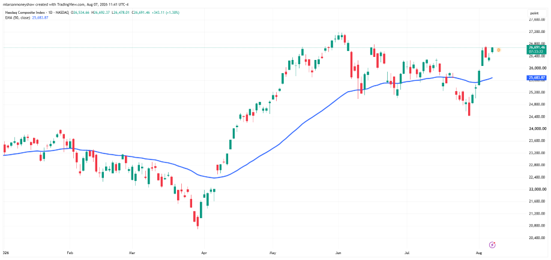
Source: TradingView
However, a closer look at the data reveals an important distinction. The first seven occurrences (1974–1991) were overwhelmingly bullish. Aside from one modest one-year loss following the January 1987 streak and a slight six-month decline after the December 1991 signal, every instance produced positive intermediate- and longer-term returns.
The 10 occurrences since 1988 tell a more mixed story. While the average four-day advance actually increased to 8.6%, subsequent gains have been more muted. One-month returns averaged just 1.7%, three-month gains averaged 6.3%, six-month returns 12.6%, and one-year gains 21.9%.
The takeaway? This relatively rare momentum signal continues to lean bullish, but today's market has been less forgiving than the markets in earlier decades. Strong buying thrusts still tend to favor higher prices over the intermediate- to longer-term, but since 1988 the path to those gains has tended to be more volatile.