
The Kospi index in South Korea has more than doubled over the past 12 months, making it the best-performing major stock market on the planet. It has also fallen about 25% since June. The opportunity is real. So, is the fragility, explains Nicholas Vardy, editor of The Global Guru.
Korea’s rally has been powered by two semiconductor giants: Samsung Electronics and SK Hynix Inc. (SKHY). Together, they make up roughly two-thirds of the MSCI Korea Index. So, when you buy “Korea,” you are not buying a diversified basket of Korean businesses — the shipbuilders, the banks, the cosmetics exporters, the carmakers. You are buying memory chips.
iShares MSCI South Korea ETF (EWY)
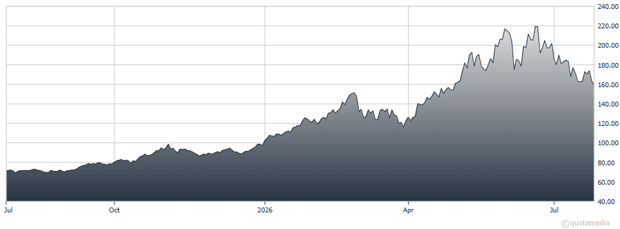
So far, that bet has been backed by actual profits — and not modest ones. Combined operating profit at Samsung and SK Hynix came to about $41 billion in 2024. Consensus now puts 2026 somewhere between $140 billion and $190 billion. That is three to four times the earnings in roughly two years, from two companies that were already among the largest industrial enterprises on earth.
But the correlation between the Kospi and the Nasdaq-100 has now reportedly reached 0.95. A reading of 1 would mean the two indexes move in lockstep.
That creates a problem most investors haven’t noticed. You may think adding Korea to a portfolio stuffed with US tech gives you geographic diversification. It doesn’t. You haven’t diversified anything. You’ve doubled down.
The danger isn’t that the earnings are fake. The danger is that investors are paying for peak earnings as though they were permanent. Semiconductors are cyclical. Shortages invite capacity. Capacity crushes pricing. Customers double-order in a panic, then slash inventories the moment supply loosens.
The bottom line? Korea offers something increasingly rare — a major stock market with direct, undiluted exposure to the biggest earnings boom of our era. It also offers something increasingly dangerous: The illusion of diversification.