
The average American federal income tax bill was $13,890 in 2022, the latest year for which we have that level of data. It takes about two American taxpayers to “fly” a single F-18 for one hour. Yet this is still just a tiny slice of US military spending. That’s one reason I’ve been recommending General Dynamics Corp. (GD), advises Nilus Mattive, editor of Safe Money Report.
This is what I was thinking as I sat in a Virginia Beach hotel room recently, the windows shaking as an F/A-18F Super Hornet flew overhead toward the open Atlantic. It happens many times a day there, as pilots take practice runs from nearby Naval Air Station Oceana.
We could sit here and debate the wisdom, necessity ,or focus of all those defense outlays forever. However, I’d rather just make two points that are indisputable.
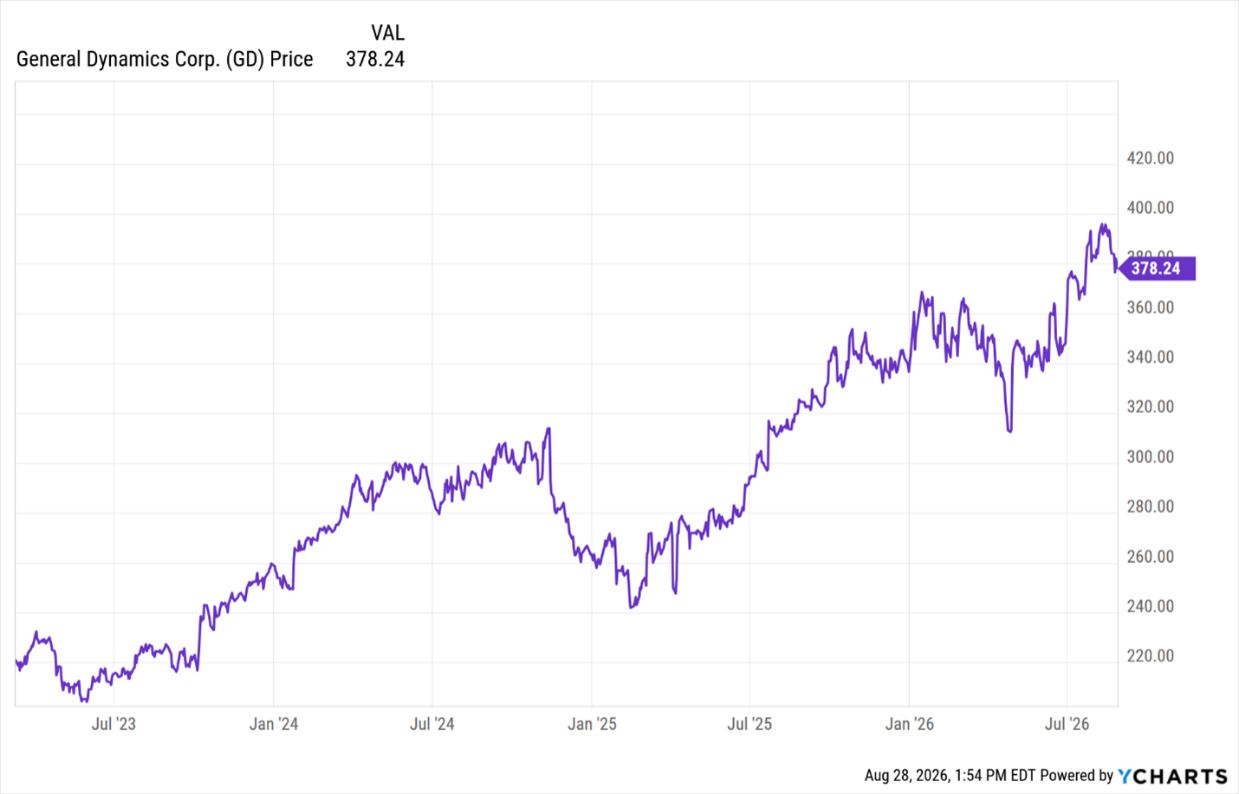
First, for investors, massive military spending is a boon. Just look at a chart of GD.
Second, while defense spending always accounts for a large amount of the federal budget, it is no longer even our country’s biggest annual expense! In 2025, Social Security was the largest part of the federal budget at 22%. Medicare was No. 2 at 15%.
However, those programs are funded — or underfunded, as I wrote recently — by their own separate taxes. Defense spending came in at 13%. The only thing now taking up more of the federal budget? The interest payments on all our country’s existing debt!
Essentially, our country has a no-limit credit card. Twenty-five years ago, our outstanding balance was $5.8 trillion. Every year since then, we’ve spent more on the card than we make. Last year alone, the difference was $1.78 trillion.
So, over time, you should expect to continue losing more and more purchasing power with every passing year. Investing in solid companies, including blue-chip defense contractors, is one way to try and keep pace.