
No good deed goes unpunished. That’s likely the mantra mumbled by disappointed owners of AI-related stocks after better-than-expected Q3 2026 results were released only to see the shares subsequently slump in price. That makes now a good time to cover the “Free Lunch” strategy, suggests Sam Stovall, chief investment strategist at CFRA Research.
After Meta Platforms Inc. (META) and Tesla Inc. (TSLA) reported beats last Wednesday, share prices initially rose in after-hours trading...only to be swept up in a tsunami of selling that dragged down the Nasdaq-100 by nearly 3% on Thursday. We also saw a slump in the 10- year yield below 5% in a flight-to-safety trade that boosted the fortunes of small caps, value stocks, and defensive sectors.
Source: CFRA, S&P Global Market Intelligence
The information technology sector is regarded by many as the poster child for volatility and returns, since it recorded the highest CAGR since 1990, along with the greatest level of volatility. Conversely, the consumer staples sector is called the poster child for stability, due to the old saying, “When the going gets tough, the tough go eating, smoking, and drinking.”
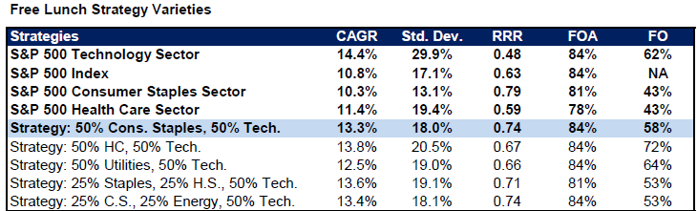
With that in mind, look at the table of “free lunch strategy variables” above. You can see an equal weighting to the tech and staples sectors since 1990, rebalanced annually, delivered 93% of the return of tech alone, with 40% lower volatility!
Not surprisingly, it delivered a higher return-for-risk ratio (RRR) and frequency of [market] outperformance (FO). The health care sector, in place of consumer staples, recorded a higher CAGR and FO, while experiencing greater volatility and reduced RRR. Other combinations also delivered market-beating results.
Therefore, as the market increases investor anxiety, a review of declines and recoveries, along with defensive diversification options, may allow investors to sleep a bit more soundly.