

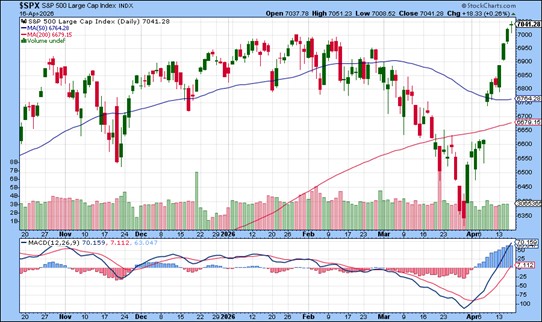
As of Thursday’s close, MACD indicators applied to the Dow Jones Industrial Average and S&P 500 Index (^SPX) were positive. But May officially marks the beginning of the “Worst Six Months” for the DJIA and S&P. To wit: “Sell in May and go away,” writes Jeff Hirsch, editor-in-chief of The Stock Trader’s Almanac.
The Dow would need to drop 4,770.50 points (9.8%) in a single day to turn its MACD indicator negative while the S&P 500 would need to decline 941.01 points (13.3%) to turn its MACD indicator negative. Continue to hold long positions associated with DJIA’s and S&P 500’s “Best Six Months.”
(Editor’s Note: Jeff will be speaking at the 2026 MoneyShow Masters Symposium Las Vegas, scheduled for July 20-22. Click HERE to register.)
S&P 500 Index (^SPX)
Our “Best Six Months Switching Strategy,” created in 1986, proves that there is merit to our old trader’s tale. A hypothetical $10,000 investment in DJIA compounded to a gain of $1,316,635 for November-April in 75 years...compared to just $4,253 for May-October. The same hypothetical $10,000 investment in the S&P 500 compounded to $1,147,286 for November-April in 75 years...compared to a gain of just $16,592 for May-October.
Indeed, May has been a tricky month over the years – a well-deserved reputation the May 6, 2010 “flash crash” only reinforced. From 1965 to 1984, the S&P 500 was down during May 15 out of 20 times. Then from 1985 through 1997, May was the best month, gaining ground every single year (13 straight gains) on the S&P.
In the years since 1997, May’s performance has been erratic. But over the last 21 years, the first three days of May have historically traded higher – and the S&P 500 has been up 19 of the last 28 first trading days of May.
Bouts of weakness often appear around or on the fourth, sixth/seventh/eighth, and after the twelfth trading day of the month. The last four trading days have generally enjoyed respectable gains on average, but the last day of May has weakened noticeably. In midterm years, May has generally opened with a gain. But by the third trading day, broad weakness has set in and lasted until nearly the end of the month.