

Defensive rotation was the trade last week. Health care, utilities, staples, and long-duration Treasuries all printed Extreme positive signals, while technology printed an Extreme negative signal — and credit confirmed it. Plus, cross-asset confluence was unusually high, writes Michael Gayed, editor of The Lead-Lag Report.
The cleanest read is that the market has stopped paying for AI growth at any price and started repricing for a Federal Reserve on-hold-with-no-cuts regime under Chair Kevin Warsh. Breadth narrowed in exactly the way that historically precedes a tradable correction in the cap-weighted index.
XLV/SPY Chart
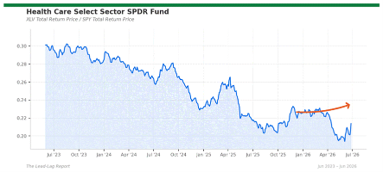
Health care is the headline. The State Street Health Care Select Sector SPDR ETF (XLV) gained 7.8% on the week — the best single-week sector performance since June 2022. Plus, the XLV/SPDR S&P 500 ETF Trust (SPY) ratio printed a +4.63σ reading, an ‘Extreme’ signal at a magnitude this framework has not generated in either direction in over twelve months.
Eli Lilly & Co. (LLY) led with an 11.6% weekly gain on renewed obesity-drug pipeline confidence and a broader sector bid that included biotech, large-cap pharma, and managed care simultaneously. The structural drag I have flagged for months was overwhelmed in a single week by a defensive rotation impulse that was as broad as it was violent.
The seasonal tailwind into midterm-year July adds confluence. The risk to the call is that a +4.63σ reading is, by definition, statistically improbable to repeat for another week. Some mean reversion is likely.
But the cleanest signal from this last report in over a year is that five defensive sectors all printed Extreme positive readings in the same week. Technology printed -2.01σ Extreme on the other side and credit confirmed risk-off. The cross-asset confluence is also unusually high: defensive equities, long-duration bonds, investment-grade credit, and the framework’s own XLU/SPY four-week rate of change all moved together.