

The market response to strong mega-cap earnings, and the knowledge that much of the recent decline was due to forced selling, has encouraged traders to leap back in to buy the big dip. So, what happens next? Here’s my take, using Lumentum Holdings Inc. (LITE) as an illustration, writes Eoin Treacy, editor of Fuller Treacy Money.
Heading into Q2 earnings, the market’s precautionary moves were significant. Several of the highest profile companies benefitting from AI infrastructure spending halved over the last six weeks. Then there was news that a darling of the AI investment boom, Leopold Aschenbrenner, was forced to sell many of his positions during this downdraft.
Lumentum Holdings Inc. (LITE)
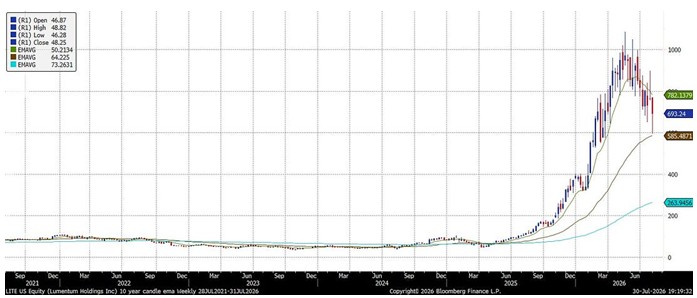
His fund “Situational Awareness” had more than $20 billion in assets as of late May, the Wall Street Journal reported. Some of its biggest positions rallied further from there before plunging in July. He might be a prodigy, but he has just learned an important lesson. The market is predatory.
If you have well-publicized positions and are overleveraged, that weakness will be exploited. Refusing to sell positions in private equity holdings means he was caught in a classic liquidity squeeze. That certainly helps to explain the large volume of supply hitting the market, which led to six consecutive weeks of declines.
From a trader’s perspective, buying the big dip is always preferrable to buying an accelerating trend. Risk management is much easier. If this rebound is going to achieve its potential, the lows will hold. If this rebound fails, the lows will not hold.
A large number of the “picks and shovels” AI stocks like LITE just rebounded sharply from the region of their 200-day moving averages. That is part of the volatility that characterizes the sector. High volatility means position sizes have to be adjusted to the reality provided by the market.