

Traders sure have their hands full. The Federal Reserve is raising interest rates to fight high oil prices and sticky inflation. Plus, regulatory and security worries are fanning AI slowdown fears. But two reliable, time-tested trading signals are still pointing to upside ahead, observes Alec Young, contributor at MoneyFlows.
Let’s start with a valuable signal to heed from the credit markets. Investors are always worrying. It’s in their blood. Credit spreads can act as an early warning signal that helps separate real signals from noise. They measure the premium companies pay above comparable Treasury yields to borrow money.
Given all the macro doom and gloom, you’d expect spreads to be widening out notably. But investment grade credit spreads are currently near record-tight levels at only 81 basis points above Treasuries. That’s well below the long-term average of 129 basis points.
Here’s the best part. Stocks outperform when credit spreads are under 1%. Since 1989, the S&P 500 Index (^SPX) has gained 12% in the 12 months following sub-1% investment grade credit spread readings versus only 6.6% average advances when credit spreads have been above 1%.
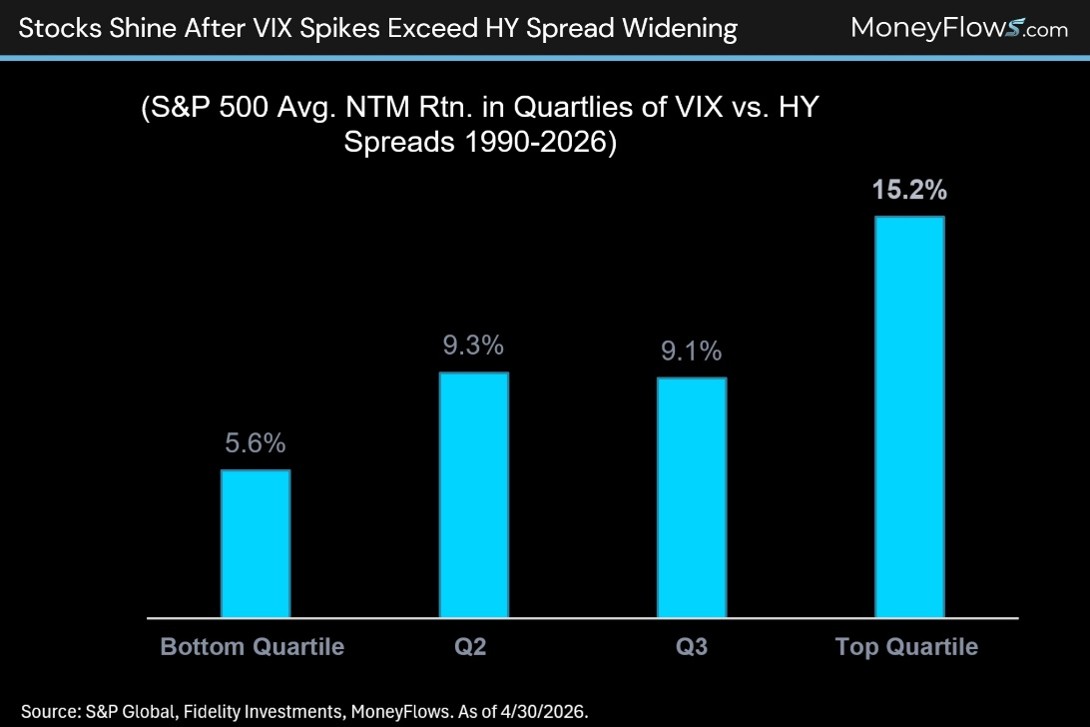
The relationship between equity stress as measured by the CBOE Volatility Index (^VIX) and credit stress (high yield spreads) holds valuable clues about what’s ahead for stocks, too. The bond market is often considered the “smarter” market, and when it fails to weaken alongside a rising VIX, it often signals that equity selling is overdone, creating a buying opportunity.
In the latest bout of risk aversion, the VIX’s rise has outpaced credit spread widening. We saw the same equity/credit dynamic in April 2025 on Liberation Day and again this past March, both of which turned out to be an epic time to buy.
Since 1990, the S&P 500 has averaged 15% gains a year after relative equity panics like we’re seeing now. Bottom line: Credit markets are telling us the macro is better than the crowd thinks.