
Ahead of quarterly earnings season, analysts have typically revised their earnings estimates lower. But what if analysts flip the script and raise earnings estimates? Should investors be concerned? Here’s my take, advises Sam Ro, editor of Tker.co.
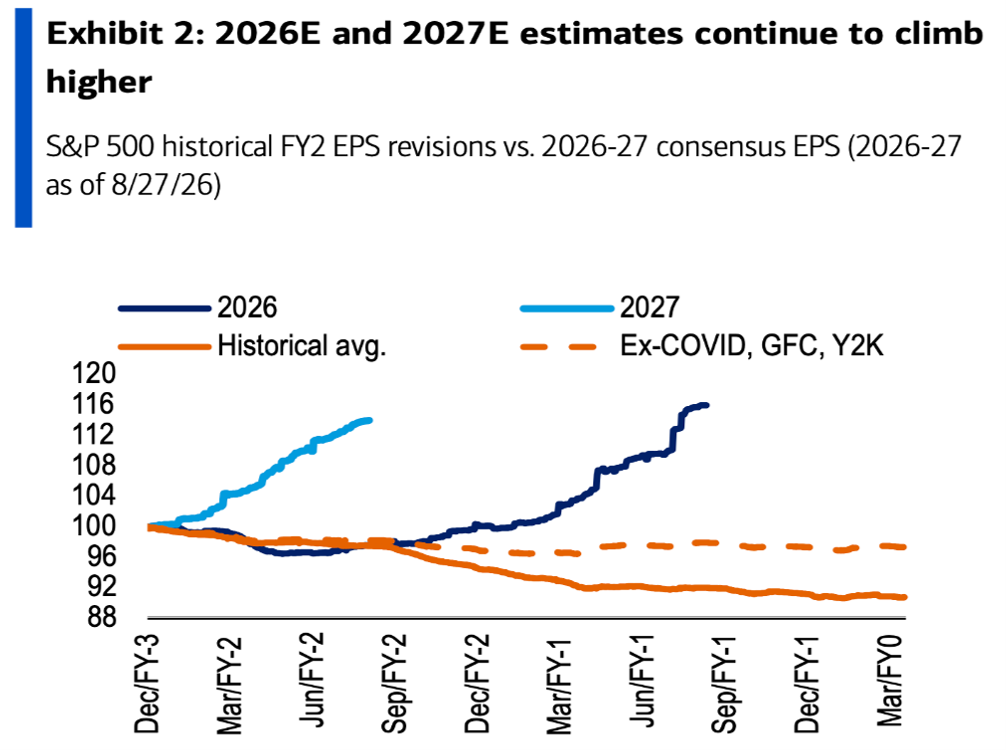
Are the odds higher that quarterly results fall short of upwardly revised estimates? I’m hearing that question more often as analysts raise estimates ahead of Q3 earnings season (which kicks off in mid-October). My response: I’m not convinced that raised estimates are any harder to beat than lowered estimates.
Source: BofA US Equity & Quant Strategy, via Tker.co
For starters, companies have a track record of clearing those elevated estimates. FactSet’s John Butters notes that analysts typically reduce estimates during the first two months of each quarter. But in this quarter, analysts have raised estimates. Pundits will remind you this is unusual.
However, analysts raised their estimates for the recently completed second quarter more significantly. And what did we learn from Q2 earnings season?
“For Q2 2026 (with 99% of S&P 500 companies reporting actual results), 87% of S&P 500 companies have reported a positive EPS surprise,” Butters wrote on Friday.
That’s right. 87% of companies beat those raised estimates. And as TKer’s long-time subscribers already know, most companies beat estimates all the time.
Bottom line: If you’re following the trajectory of analysts’ quarterly estimates, upward revisions aren’t something to worry about. Analysts tend to move estimates so most companies beat them, and by a margin of about 5%.