
A shift in the US 10-Year Treasury yield from 4%-4.5% up to 4.5-5% has initially triggered a knee-jerk, negative reaction in financial markets. But equity markets do not trade on interest rates in a vacuum. They trade on the reasons WHY rates are moving, explains Bryan Perry, editor of Cash Machine.
Traditional stock market theory holds that higher risk-free rates squeeze equity valuations by raising corporate borrowing costs and elevating the discount rate on future cash flows. But when a yield adjustment is driven by robust real economic expansion rather than unchecked stagflation, stocks not only tolerate higher yields, but they also routinely appreciate alongside them.
Current real US Gross Domestic Product is running at a strong 4.4% pace for the third quarter, per the Atlanta Fed GDPNow reading released on Sept. 10. When combined with a baseline inflation rate of around 2.5%, projected nominal GDP growth reaches 6.9%.
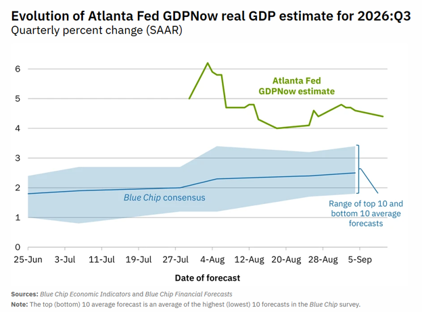
As long as nominal GDP growth - call it 6.9% - is greater than the 10-year Treasury yield - recently at 4.97% - the stock market can remain constructively bullish. Corporate top-line revenue tracks nominal economic growth, not real GDP alone. If nominal economic output expands at nearly 7%, companies generate sufficient revenue expansion to easily absorb a 4.5%-5% hurdle rate.
One other thing to keep in mind if you own something like the SPDR S&P 500 ETF (SPY): Prior to the 2007-2008 Great Recession, 10-year Treasury yields were higher than modern investors are accustomed to seeing.
Yields routinely fluctuated between 4% and 6.5%, averaging roughly 5% to 5.5% over the decade spanning 1997 through 2006. Equity markets did not just tolerate these higher rates. They experienced two of the strongest structural bull rallies in history.